Monday, 9 February 2015

12 week year №1. Week 1.

So here I am, finishing up The Defining Decade, planning to write a review on it while I haven't even written any review on The 12 Week Year yet. Plus I'd like to share some notes and ideas concering my first lessons with new groups, which happened yeasterday and today. And it's already 1:30 a.m. So I'm a bit confused whether I should go to sleep and deal with all the blog entries in the morning or stay and deal with at least one right now :)

Well let's follow the advice of not putting off until tomorrow what you can do today. Besides reflecting on a week achievements is probably more logical on Sunday than on Monday.
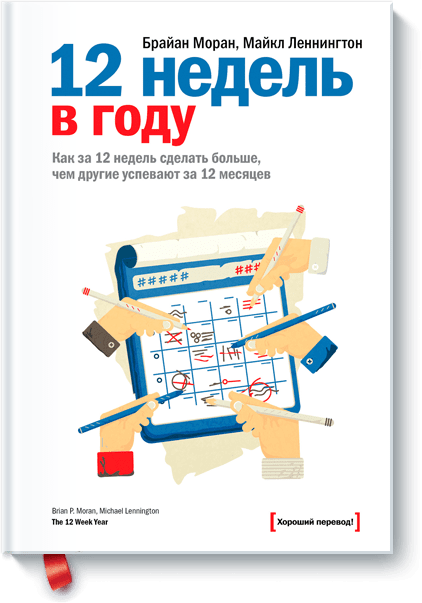
First a few words about the 12 week year system. It's a time-management approach, which supposively enables you to be more effective and reach your goals. As it's described on the official website (link here) and in the book which I had a great pleasure to read (amazon link here and Russian version link here), people tend to draw plans in January, very inspiring
month, the beginning of the year and put off their realization till December, when it's already impossible to learn a new language to A2 level, loose 15 kg, go to gym and so on. So instead of year planning, the authors suggest that we should make plans for the following 12 weeks and set goals that can be achieved within that time period. You treat 12 weeks like a year now. This period is not too short to set ambitious goals, and what's more important it's not too long to let you procrastinate. If you imply this system, you are going to have a New Year every 12 weeks. Every 12 weeks you are going to look back and five yourself a detailed feedback on what was effective and successful and what can be improved. The authors even suggest to take a small vacation after each 12 weeks so that it feels like real New Year to you.

The 12 week year results are achieved thanks to scrutinuous weekly planning and estimation. 1 week is your new 1 month now. And with such pace - yeah, you better hurry up. Now, I must confess, that I've been really bad with keeping up with set goals and standards this week. I'm going to count the effectivness rate now and oh I hope that the low results will motivate me to try harder next week =)


12 week year, week 1 results


Selfdevelopment (piano, dancing, reading) - 33%

Personal effectivness development (planning skills, maintaining the house) - 35%

Studying (University) - 0%

Work and professional development (work duties, extra activities for prof.development, special courses and trainings, new methods implementation, professional effectiveness) - 50%

Health and beauty (diets, personal care, healthy habbits) - 59%

Family and friends (relations improvement, time devoted for family and people i love) - 75%

Overall week effectivness: 40%

Thursday, 29 January 2015

Seminar on using videos in ESL classroom at British Council

Today I had a chance to attend a seminar on using videos in classroom. It was very nice and useful indeed and I thought I should share with you what I learned and what seemed to be interesting there.
Well, first of all the seminar itself was rather interactive – the speaker tried her best to engage the audience as much as possible which helped to make the meeting more beneficial and, what’s probably even more important, vivid.

I should probably divide the info I’m going to post into three blocks: ideas on using videos in the classroom, useful resources and some other info.

1) Ideas to use with videos (which were discussed, which just came to my mind while I was there, which were shared by other teachers):

- as a lead-in or a while watching activity we can cover/ the video or turn the laptop’s screen away from the students and let them guess the topic and the motion picture by listening to the sounds alone;

- as a lead-in - give a shortcut from the video before watching it so that students can make their predictions. The trick here is to give as controversial image as possible, try to lead them away from the topic as much as possible, make them use their brain :D you can also ask them to make the most positive/peaceful prediction they can and the most negative/violent one. Picture of a woman with a gun was shown at the seminar. Turned out, she wasn’t a refugee or something ;)

- as an after-watching activity to spur children’s imagination we can ask them to put themselves in the characters’ shoes and imagine what they were thinking at some particular moments of the videos. As it’s an activity aimed at creativity encouragement, let your children go wild with their ideas;

- as an after-watching activity you can ask your students to do the voiceover themselves. The idea is – take for example the introduction part or some other particular piece, turn off the audio and tell students that it’s going to be a different video now, that is change the purpose of the video. For example, if the video is actually about sharks, tell them that this piece is a resort advertisement now, and they need to write the script for the voiceover to that advertisement. For lower levels we’ll probably have to provide some leaflets on the same topic for extra help;

- as an after-watching activity you can ask your students to be editors. Ask them: would you change any pics/phrases in the video? What would you add to make it funnier? What would you add to make it more dramatic? Etc.

- as part of HW, we can ask students to make videos themselves on some particular topic. I think it’s a great idea, they’ll probably love it. I’ll try it on my students soon=)

2) Some other info I learned at the seminar:

- according to the 2004 study by the age of 21 young people of the USA spend 5000 hours on reading, 10000 hours on playing video games, 20000 hours on watching TV;

- there are such things as “flipped classrooms” (and it’s about schools, not universities) – teachers record lectures on video and give them to students as homework. So children watch/listen to all the necessary theoretical info at home. So when they come to school, all they do at the lessons is interact with the material – do exercises, make experiments, discuss and so on. There are even some schools that operate that way only;

- there is such term as “prosumers” (and it was offered by some writer whose last name I failed to remember). It refers to today’s people who no longer want to consume information, but want to interact with in many different ways (in one word that is use it).

3) Useful materials:

- videotips.cambridge.com – a competition for Eng teachers. Check it out, prizes are cool and the topic is quite unusual

- englishyappr.com – videos for ESL

- englishfilm.com

- course “Unlock” by Cambridge university press – for adults, teaches critical thinking at lower levels, built-in IELTS preparation, lots of built-in videos

- Cambridge Discovery Interactive Readers – interesting topics, CLIL approach. You can see an example of one book from this series on the photos, I won it as a prize in a small quiz at the end of the seminar :)


- course “Eyes open” – 4 videos per unit, brand new course

This is probably it. The photos in the middle of the post illustrate table tennis standing right in the conference room which I think is pretty amazing and fun :) and some secret door that leads to….maybe London? :)
Reading The Defining Decade by Meg Jay. Intro + Chapter 1 of Part 1. Job

To make my reading more effective I decided to give some feedback on chapters from the books that I read and provide a final review when I finish.
So today I started reading a New York Time's bestseller which has been translated to dozens of languages and has reaped glory all other the world for being "excellent" and "just the right book for people of 20-30". It's The Defining Decade: Why Your Twenties Matter And How to Make the Most of Them Now ( Amazon link here) by Meg Jay.

To start with, I'm enjoying the book so far (so far means about 60 pages) and it can be definitely called inspiring and thought provoking, as quite often I found myself thinking Hmm I want to reread those paragraphs. To get better understanding, you know, so that some things settle in mind better.

Anyway, for starters I'd like to start with listing key points/main ideas (or at least those points that appeared to me to be such) of those two parts that I've read.

Intro. Living in the real time.

  • The meaning of all the open doors in front of you when you are 20 is overestimated. Young people of that age are waiting for great opportunities and roads ready to take them anywhere they want, however no one has warned those young men and women that it's hard to make decisions, make choices, explore and grab the opportunities. Young people face problems of unemployment, unpaid rents and loans that nobody told them about. It's like they are thrown into the ocean of opportunities and they can swim in any possible direction. However there's no land to be seen so they don't know where to swim to. There's great instability in their life in that period, which causes huge stress, depression.
  • Those who are in their 20s now are not taken seriously. They are called "pre-mature", "grown up children", "young adults" or even "not yet adults". They would like to tackle serious matters and be treated like grown ups, but really few people want to discuss important issues with them and find out their opinion.
  • The 30s aren't the new 20s. Well, first of all, we can't expect our 30s to take care of everything we didn't have time to do and complete when we were 20. We can't put away life decision, career choices and stuff as important as these for later. Secondly, when you are 30 you have less strength and potential to do certain things. Making no choice is also a choice.
  • Parents of those who are in their 20s now were in too much hurry to live which left them with getting married and getting a job early. So now they advice their children to take their time (or children just see their parents' example and do not want to repeat their way of living) in such matters as career development and family building.
  • Young people in their 20s spend time carelessly. They know that there's a whole life ahead of them (and it's full of great things waiting just for them of course) and they waste their time.
  • Time period from 20 to 30 is the real time that needs to be lived through reasonably, for a proper purpose, in a benefiting way. It's the most important part of our lives as it's exactly this period when we meet people crucial to our ideology and mind set shaping and when we make life changing choices.

Monday, 26 January 2015

Storytelling. Part 1.

So here I am, preparing for my new post for the Teacher of The Year at Unium, watching different TED videos and reading articles on storytelling. I decided to make the topic of Creativity my field of study for the next post. Hopefully I will be able to gather some interesting material. So I would like to share with you what I have learned so far.

At first, I'll share two the most interesting videos I came across today, one by J.J. Abrams and anotther by Andrew Stanton. You'll enjoy watching them both for interesting ideas and for fun. Greatly inspiring as well by the way.


Just to leave it here - new vocab for me from these videos. Loved those words, so not to forget, I'll put them here.

Venerable - accorded a great deal of respect, especially because of age, wisdom, or character.
E.g.a venerable statesman


Ubiquitous - present, appearing, or found everywhere.E.g.: - his ubiquitous influence was felt by all the family- cowboy hats are ubiquitous among the male singers


To snatch - quickly seize (something) in a rude or eager way.E.g.: she snatched a biscuit from the plate


Punchline - the final phrase or sentence of a joke or story, providing the humour or some other crucial element.E.g.his humour did not depend on punchlines

And now I'd like to list some points and try to reflect on them a bit:
  • Storytelling is joke telling.
  • Stories affirm who we are. Each person creates unique stories and character. All of that reveals our mood, intention, values, concerns and matters alike.
  • Stories cross the barrier of time. They serve to transit culture and history. Some stories survive trough ages being told from mouth to mouth.
  • Stories help us discover similarities between each other. Why do some films and books become more poplar than others? Why do people from different countries, of different age and sex find the same stories attractive? Because they appeal to problems that people face all over the world. We all are similar. Like Tolstoy said, all happy families are alike, each unhappy family is unhappy in its own way. But even those ways of unhappiness are similar, each case has its particularities, no doubt. But the base, the eternal questions, are the same. It's one of our greatest strengthes as mankind, I believe.
  • There isn't anyone you couldnt learn to love once you've heard their story. No comment needed. Just a very profound idea.
  • Story commandment is - make me care. We feel touched by a story the moment we start to care for the characters. 
  • Good story should make a promise that it will lead somwhere that's worth your time.
  • Storytelling without dialogue is the purest form of sinematic storytelling.
  • Audience wants to work for their meal. They just don't want to know that they are doing that. We are born problem solvers. It's a well organized absence of information that draws us in.
  • Unifying theory of two plus two. Make the audience put things together. Don't give them four; give them two plus two.
  • If things go static, stories die. Because life never is static.
  • Drama is anticipation mingled with uncertainty.
  • Questions you can ask yourself:
  1. Have you constructed anticipation?
  2. In the short-term, have you made me want to know what will happen next?
  3. But more importantly, have you made me want to know how it will all conclude in the long-term?
  4. Have you constructed honest conflicts with truth that creates doubt in what the outcome might be? 
  • Storytelling has guidelines, not hard fast rules.
  • You've got to love your main character.
  • A strong theme is always running through a well-told story.
  • Story needs to invoke wonder.
  • Express values you personaly feel deep down in your core.
  • Mystery is the catalyst for imagination.
  • Blank page is a magic box.
  • First - give a teaser.
  • Mystery after mastery - solving one mystery leads you to another (it can be apllied just to characters, appearing one by one in the book).
  • Leave room for imagination to the reader.
  • What audience think they are getting shouldn't be what they will really get it the end.
  • Storytellers need to develop their characters, go deep into character's actions and attitudes.
  • The only thing ripped off in the story should be a character. 

Sunday, 25 January 2015

Sherlock Holmes Quest

Today was our last lesson in this semester and I'm really excited right now about strating the new Intermediate textbook in two weeks with my elder students!
I hope that all of them will stay in the group, we'll add couple new faces and start fresh and kickng right away!


I would like to share with you ideas and materials I used for our last lesson. We always try to make it special - prepare a quest or some game. Last lesson I offered them 4 topics to choose from and everybody agreed on Sherlock Holmes.

So that's how our Sherlock Quest lesson went today:

1) Find the next clue. Children teamed up into 2 groups (I have only 5 students in this group) and ad to run around the Educational Centre to find the clues of their team colour which would lead them to new clues and so on till they found the last ones that had secret words written on them. Some of the clues contained not only directions, but also small tasks like find out how to say hello, bye and thank you in German (that was in a German classroom, the teacher of which agreed to help me) and find out the EC manager's name.

2) Create your own Detective Agency. Children had 10 minutes, lots of markers and a piece of paper for each group to create a symbol, a moto and come up with a name for their Detective Agency.

3) Meeting the victim. The Agencies received their first calls. It was an old lady who had been robbed. She told her story where she and her cat Mr.Whiskers were drinking tea when the accident happened. What she saw was only a black figure climbing out of her living room window. There was only her neighbour with a baby walking down the street, the gardner who must have been doing his work in the backyard and no other witnesses. So the detectives decided to go to the gardner first.

4) Witness number 1. The gardner was a lonely old man living with his owl. He didn't want to say anything till somebody played the Story game with him while drinking 5 o'clock tea. I found this game at the EC and it's designed to spur children's imagination and develop storytelling skills. It's called Rory's Story Cubes and you can buy them either "in flash" or purchase an app, which is three times cheaper. The real dice feel great in your hands though. So the thing is that each side of the dice (there are nine of them in the box) has a picture on it. Player rolls nine dice and gets nine pictures. He needs to make up a story that will contain all of those words now.
After having played the game the gardner decided to share some info.

5) Wintess number 2. The young lady that was wallking down the street with her baby in hands that night was very nice and agreed to answer all the detectives' questions. She only needed some time to run to the grocery's and buy some milk for the baby. Meanwhile she asked the detective to look after her chiled and play sharades with him. Here I took some words from the units we studied this semester, wrote them on cards and put either S, T or D at the bottom of which card. S is for show, T is for Talk, D is for Draw, so now guys needed to take turns to get the card and either mime, explain or draw the words.
When the lady came she answered all the questions and the detectives found out that her husband saw Mrs.White's husband 1 week ago, which was really strange because Mr.White left the town 2 years ago when he and Mrs.White got divorced.

6) Witness number 3. The neighbour's house was at his workplace and worked really hard to catch up with his deadlines so he didn't really have time to talk to the detectives. The detectives decided to help him to write the articles (this man was a journalist) and therefore save him some time to talk to them. Here are the topics that I offered to my students (they had 15 minutes to write 1-2 paragraph stories):

  • You are building a sand castle and suddenly notice that the sea has brought something to the beach from its deep waters. You come closer and see that it’s a bottle with some sheet of paper inside. You open it and here is what the paper says:
  • You are walking the streets and at some point an old man and an old lady approach you. It turns out that it’s exactly you who they need for one secret mission…
  • You are walking the streets and arrive at a narrow one. All the houses there have dirty grey walls, doors and windows except for one house that stands at the very end of the street. It’s bright blue and has a yellow roof. Who lives in this house?
  • Write a story where you will mention a girl with a pot with honey, a bear, a street lamp
  • You and your friends are camping in a forest. It’s an early morning and you and your best friend decide to have a walk. You find a tree with a nest on it. The nest is full of golden eggs. One of the eggs is opening….
  • “That’s where the rainbow ends!” – Lilly cheerfully cried out loud. It was a very interesting place indeed….
  • And all over the room there were… pancakes! Here is how it happened.
After having helped the man they learned that he saw Mr.White at the Glade's Bar last week. Mr.White was talking to some tall skinny blonde guy and was pretty nervous.

7) Witness number 4. At first detectives had to find the right person at the bar buy matching pictures of young men and appearance descriptions. Once done, they started asking the tall blonde buddy questions to which he was reluctant however. He wanted to gamble with them at first. Cluedo game was very popular in that bar and the guy agreed to tell them everything he knew only if they win this game. So we played cluedo (there were 6 of us all together, so it went perfectly). Here is the Amazon link to the game in case you don't know it. I was lucky to have it at my EC, but I think you can make one yourself (I'm planning to, because it's rather expensive).
The gambler told the detectives that Mr.White discussed theft with him and ask for advice. The gambler however didn't know where to find Mr.White.

8) Witness number 5. When the detectives were leaving the bar a girl approached and said she heard them speaking and could take them to Mr.White. She showed them the house and in order to thank her detectives decided to play with her. Any game you find funny at useful at the same time would fit this step. It would be great if the game was active as well because after playing Cluedo children get tired sitting and want to move around.

9) The Mansion. So detectives arrived at the mension. It has three floors and 16 windows + 1 window on the roof. Mr.White is in the attick so to get to that roof window children need to go through those 16 first. Each window (as you can see on the picture) has a sticker on it. Some stickers tell you that you earn 2-5 extra points, some tell you that you loose 1-3 points, some give you small tasks like sing your fav English song and get 5 points, say these three tongue twisters in a raw without any mistakes and get 7 points, and some imply completing a worksheet on one of the topics of the semester.

10) The arrest. You got that old evil man! Now to finish up your quest in a fun way act like poor Mr.White, make couple jokes, say something funny, thank the detectives on behalf of Mrs. White and even draw a cell on the Mr.White's picture.

Some extras you need to/may apply:

  • Don't forget to score. Give points (and reason the number of points given) for each task. Calculate all the points at the end and reveal the winner;
  • Act out the characters. Take up the roles of the witnesses and make it fun. I printed out pictures of each witness and their house/room/office and added some character pecularities to each. For example, my gardner had an owl that he was always talking to; the gambler was stupid and talked with his mouth full; baby's mother was too energetic and active, wouldn't stop talking and so on;
  • Give useful prizes for the winners (e.g. copybook for foreign words, small English proverbs dictionary);
  • Play Sherlock Holmes OST music in the beginning and then put on some music when children work on tasks and worksheets.
I hope that some of this information will prove useful to you :) you are very welcome to try out these ideas at your lessonsand leave a comment about how it all went.

Thank you very much for reading and do not hesitate to share!

Sunday, 18 January 2015

American English vs Russian

Today I came across a very interesting youtube channel run by a very funny guy who travels around Russia ans gives lessons together with recording some video lessons which are free of charge.

I'd like to give direct links to his resources and post one of his videos on rather unusual topic on some English-Russian slang equivalents. Dear Philochko, I think you are great! :) Thank you for what you do, for your positive videos and for contributing to American-Russian friendship! :))) 


http://www.youtube.com/user/philochko - Youtube channel
http://vk.com/philochk0 - VK community
http://vk.com/philochko - personal VK page

Saturday, 17 January 2015

Learn to learn: tools for selfdevelopment

Today's post is going to be devoted to tools that I use to develop my skills and abilities: both personal and professional.
The idea to write a post on that topic belongs to The Teacher of The Year contest organizers at Unium. It's one of the topics we are supposed to wirte on as the second challenge on that competition. So I decided to make this post useful for everybody and provide some great apps I've been using to have fun and improve my skills.

Selfdevelopment tools, sites and apps


  • Lumosity. This is probably the most famous one of all. It's an application that provides games to train the following skills: memory, speed, attention, flexibility, problem solving. There are two versions: free and pro. At the very beginning you are offered a test to check you attention, speed and memmory on the basis of which (+on the basis of a short survey on what skills you want to imrove) your personal training programm will be developed. In free version 3 games a day are provided; you can play them as many times a day as you wish. In pro version 5 games a day are recomended for you to play (based on your goals and first test results), but you have constant access to all the 40+ games that actualy exist in this program. In both versions you can set training remainders so that your device will remind you once a day to do the brain workout. At every point of the app usage you can go to the My brain page and see your LPI (Lumosity performance index) - picture on the right. However comparing your LPI with other users' is only available in the pro version. The app suggests training 3-5 days a week. Besides the actual games you receive quite interasting articles on how the brain work issues once in a while. Available for iOS, Android, Windows and also at the original website.

As for my personal comment on this app, I must say that it's fun! Games are really nice, interactive, quick and colourful. You get scores every time and have separate record tracking for each game so that you can always see your progress. In my University group we all have this app and from time to time compare our LPIs. I would definitely recommend to give it a try, especially since the free version provides so many opportunities and you don't need to pay any money to train your brain regularly.
  • Elevate. This is another personalized brain trainer which however aims at a bit different skills and abilities: speaking, writing, reading, listening, math. Those are rather channels through which you give and receive information. There are about 25 activities overall that help you to develop the most necessary skills. At the beginning you are asked about the skills you would like to improve. Then a special training programed is developed for you. Each day you are given a chance to train three of the skills via playing interactive games. You also have milestones which are fun to reach aand make your training process more interactive. This app suggests training at least 4 days a week to get the best results. Ranking is also available in pro version which can be easily purchased. Available for iOS, Android and also at the original website.
Writing about my personal usage experiance I must say that first of all it's a great tool for English teachers and students. Not only is it listening that's trained (well obviously, cuz the app is American) during the process, but also spelling, grammar and vocab range! Which istruly amazing! I'm definitely going to "advertise" this app to my students next semester (as they are going to be Intermediate now;). Interface is very nice, activities are challenging, interactive ad interesting, It is definitely worth trying.
  • Brain+. This app is focused on such skills as memory, problem solving and attention. There several sections: Brain Profile page, where you have both overall results and separate skills results measured in BP (brain points); Brain Coach explains how Brain+ will help you to improve and developed (very interestinng to listen to this info); Science - a great collection of articles on how the provided games develop your brain, on how brains work and general and so on; Training, where you actually play games. Available for iOS and also at the original website.
As I have just started usinf this application, there is not much that I can say, but so far my experince has been nice and brightful. I really like the science section, where a lot of info is provided. It's nice not only to lear stuff about brain but also find some new vocabulary as I'm not a native English speaker.
  • TED. I think this site doesn't really need any presentation. Great source not only of educational videos on a vide range of topics, but also a very nice resource for me as an English teacher - to show some pieces or some shorter videos to my students to do some tasks. As most of the lecturers who make videos for TED are great preformers, their speech is usualy eloquent, well-structured and pronanciation is quite easy to figure out. That's probably all I'll say about TED. You should definitely check it out if you don't know this resource yet.
I very sincerely hope that at laest some of this info will prove useful to you :)

Thursday, 15 January 2015

The Power of Yet by Carol Dweck

So here is a short but very informative video on a Not Yet strategy worth watching. Not only it suggests some practical tips, but also inspires.

As I've been trying to derive more from what I read and what I watch, I decided to use techniques of wise reading (which can be transformed into wise watching I guess). In attempt to get as much as possible from this video I created a short summary of the video while listening to it for the second time. So now I'm going to write it down here, trying not to look at the notes I took but rather by remembering stuff.

I hope it will also be useful for you and will save your time as the sketch I made includes all the main ideas, so if you don't have 10 mins to watch the video, you can just spend 2 mins looking through the sketch.

The Power of Yet
  • There are children with fixed mind set and growth mind set:
- GROWTH mind set children 1) like challenge and 2) understand that their abilities can be developed
- FIXED mind set children are scared of hard tasks and when having failed at their first attempt (according to the study) next time are likely to 1) cheat 2) look for someone who did worse than them in order to feel better 3) run from difficulties
  • Fixed and growth mind set children treat errors differently:
- GROWTH mind set children process the error, learn from it and correct it
- FIXED mind set children run from error and don't engage with it
  • To build the bridge to Not Yet set of mind we can:
  1. Grade "Not there yet" instead of "Failed"
  2. Praise wisely: do not praise for intelligence and talent, but praise for process, strategy and effort
  3. Reward students for progress, not for the results right now
  4. Teach students about the growth mindset, i.e. provide them with info that every time they push out of the comfort zone to learn something new, neurons in their brain form new stronger connections. And, as a result, they get smarter 
  5. Consiquently transform the meaning of effort and challenge into the right and more positive one
All the info and steps mentioned above need to be kept in mind and put into practice in order to build self-confident personalities who are not afraid of learning and making mistakes.

How to learn a new language: 7 secrets from TED Translator

They say that children learn languages the best. But that doesn’t mean that adults should give up. We asked some of the polyglots in TED’s Open Translation Project to share their secrets to mastering a foreign language. Their best strategies distill into seven basic principles:
  1. Get real. Decide on a simple, attainable goal to start with so that you don’t feel overwhelmed. German translator Judith Matz suggests: “Pick up 50 words of a language and start using them on people — and then slowly start picking up grammar.”
  2. Make language-learning a lifestyle changeElisabeth Buffard, who in her 27 years of teaching English has always seen consistency as what separates the most successful students from the rest. Find a language habit that you can follow even when you’re tired, sick or madly in love.
  3. Play house with the language. The more you invite a foreign language into your daily life, the more your brain will consider it something useful and worth caring about. “Use every opportunity to get exposed to the new language,” says Russian translator Olga Dmitrochenkova. Label every object in your house in this language, read kids’ books written in it, watch subtitled TED and TEDx talks, or live-narrate parts of your day to an imaginary foreign friend.
  4. Let technology help you out. Dmitrochenkova has a great idea: “A funny thing like resetting the language on your phone can help you learn new words right away,” she says. Ditto for changing the language on your browser. Or you can seek out more structured learning opportunities online. Dutch translator Els De Keyser recommendsDuolinguo for its gamified approach to grammar, and Anki for memorizing vocabulary with its “intelligent” flashcards.
  5. Think about language-learning as a gateway to new experiences. To Spanish translator Sebastián Betti, learning a language has always been about focusing on the experiences that the new language would open up, from “visiting theme parks, attending air shows, enjoying cowboy poetry and folk-rock festivals, to learning about photo-essay techniques.” In other words, he thinks of fun things that he wanted to do anyway, and makes them into a language-learning opportunity. Many of our translators shared this advice. Italian and French translator Anna Minoli learned English by watching undubbed versions of her favorite movies, while Croatian translator Ivan Stamenković suddenly realized he could speak English in fifth grade, after years of watching the Cartoon Network without subtitles. So the next time you need a vegan carrot cake recipe, find one in the language you’re trying to learn.
  6. Make new friends. Interacting in the new language is key — it will teach you to intuitively express your thoughts, instead of mentally translating each sentence before you say it. Find native speakers near you. Or search for foreign penpals or set up a language tandem online, where two volunteers help one another practice their respective languages.
  7. Do not worry about making mistakes. One of the most common barriers to conversing in a new language is the fear of making mistakes. But native speakers are like doting parents: any attempt from you to communicate in their language is objective proof that you are a gifted genius. They’ll appreciate your effort and even help you. Nervous about holding a conversation with a peer? Try testing your language skills with someone a little younger. “I was stoked when I was chatting with an Italian toddler and realized we had the same level of Italian,” recalls German translator Judith Matz. And be patient. The more you speak, the closer you’ll get to the elusive ideal of “native-like fluency.” And to talking to people your own age.

Posted by: TedstaffNovember 4, 2014 at 5:10 pm EST. Original - http://blog.ted.com/2014/11/04/how-to-learn-a-new-language-7-secrets-from-ted-translators/

By Krystian Aparta